Thursday, 16 February 2012

Day 4 – Visit to Rural Community and School


Together with JESE staff, we travelled on some rough/dusty roads for about an hour before arriving at a small rural community, called Mwarro Village.  It was home to about 45 houses/300 people.  We spent about 2½ hours with several community members of all ages and were able to have a very good visit. 
Front seat view travelling to Mwarro Village
We first visited a new shallow well funded by WaterCan which is currently under construction.  The old water supply was not suitable for drinking water – only wash water (thus they had to travel quite far to get their drinking water).   By talking with one of the JESE staff, I learned the new well (suitable for drinking) cost about $3,000 (Canadian $) to construct, not including the labour and materials supplied by the community members.  Note that before any well (or latrine) is constructed, a process is followed to confirm the needs of the community, their desire to participate during construction and their ability to operate it in the long-term.
Original Water Supply (shallow spring)
New shallow well, just up-hill from original water supply
At new well site (JESE, WaterCan Study Group and members of the Community)
Next, the community showed us some of their homes/properties.  In summary, they are very poor and have next to nothing.  One of the girls explained that her job each day is to get the water (5 yellow gerry cans) for her family of four. One of the boys (about 14 years old) asked me if I could give him a new bike.  A man asked the group if we could pay for a new metal roof.  As you can imagine, this experience of seeing people live with only basic supplies is something I will never forget.  Just before leaving, one of the community leaders gave the WaterCan study tour group a basket of eggs and several large stocks of sugarcane to show their appreciation. 

Two boys watching intently
small house with proper dish washing set-up

Girl who gets water each day
WaterCan Study group along with some community members
 
After leaving this community, we travelled a short distance up the road to the Rwanukoora Primary School.  This school was bigger and more sophisticated than the previous school we visited (on Day 2) with about 150 students (my best guess).  When we arrived, the oldest kids (about age 13 +/-) gave a very nice presentation (singing, dancing, speech, etc,).  Once again, I was proud to present the group 5 soccer balls which were well received.  
Warm greeting by the younger children

13 year old boy reading a speech about the new water/wastewater facilities and hydien education program
Loving their new soccer balls

New (female) latrine
Then we visited the new water and wastewater facilities funded by WaterCan.  They consisted of a new latrine and water supply (rainwater collection from school roofs).  

 For the last part of the visit, all the school children gathered together and sang a few songs for us and we also (impromptu) sang ‘O Canada’ for them!  The whole school visit was again quite touching for me and the rest of the group.  It’s hard to describe the feeling one gets when all the school children are so pleased about our visit because we represent the WaterCan funding, which ultimately improves their school experience, their overall health and even their future.
All the children lined up by class, singing for us!!

To close out the day, we finally did some exercise while visiting some caves and an old volcanic crater (beautiful scenery), then made it back to the Ruwenzori View Guest House in time for a homemade dinner.  After some blog writing, I hit the hay!

Sunset while walking along the top of a volcanic crater

Day 3 – Travel to Fort Portal

Today was a travel day from Kampala to Port Fortal in western Uganda.  We traveled in a comfortable 20 person bus from about 9 am until 4 pm, at which time we had a lunch.  I was lucky enough to get the front seat of the bus beside the driver so I got the perfect view for the trip.  Unlike Canada, where we typically have either 2 or 4 lane highways to get us between cities, the highways are quite slow.  This was mainly because you have to slow down every time you pass through a small developed area (which is often) or you pass by a school.  They use a series of small speed bumps instead of a yield sign to slow you down which makes for a very rough ride.  To-date, I have not seen a traffic lights in Uganda and I don’t think they exist, only speed bumps and round-abouts.

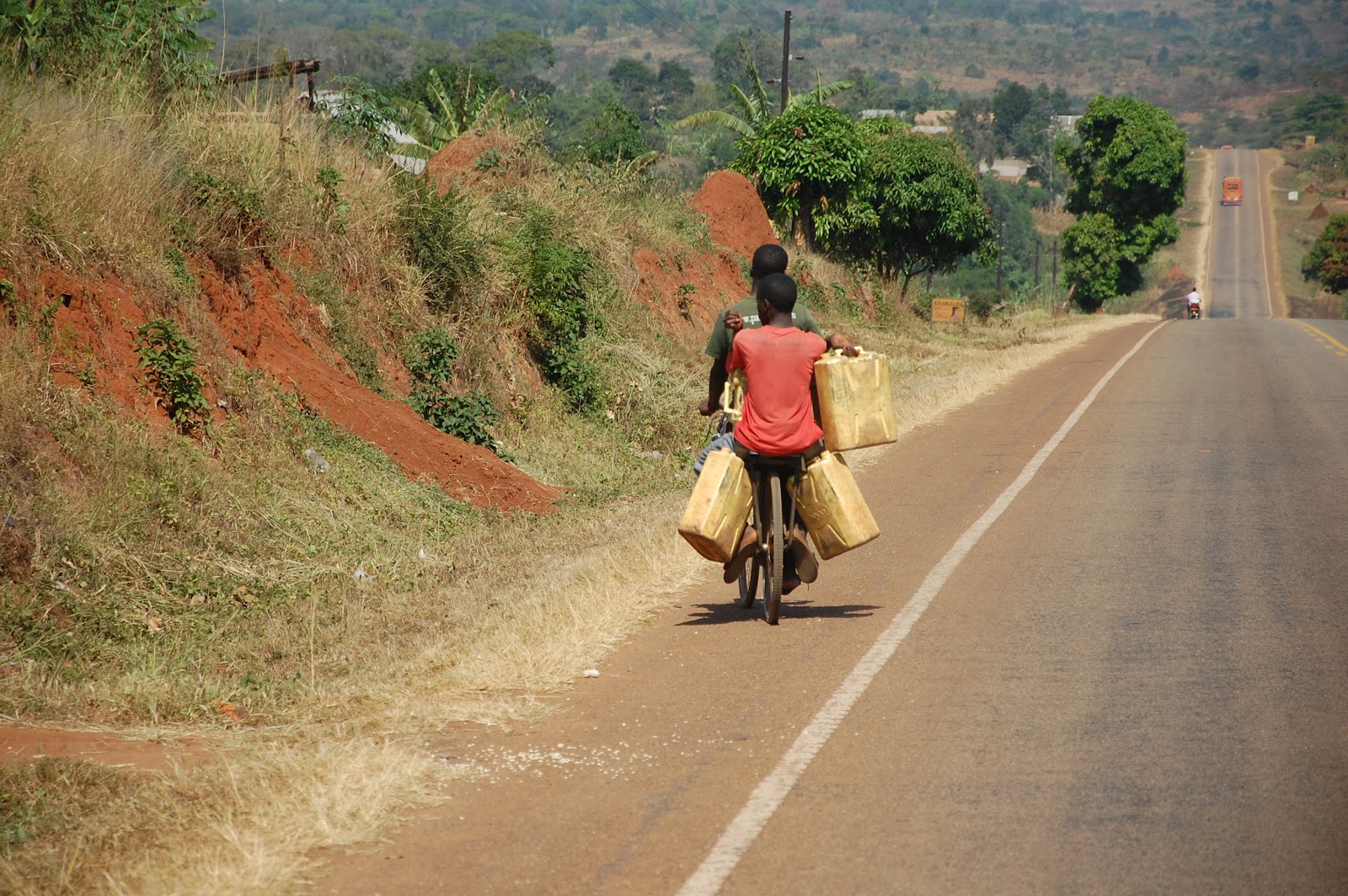
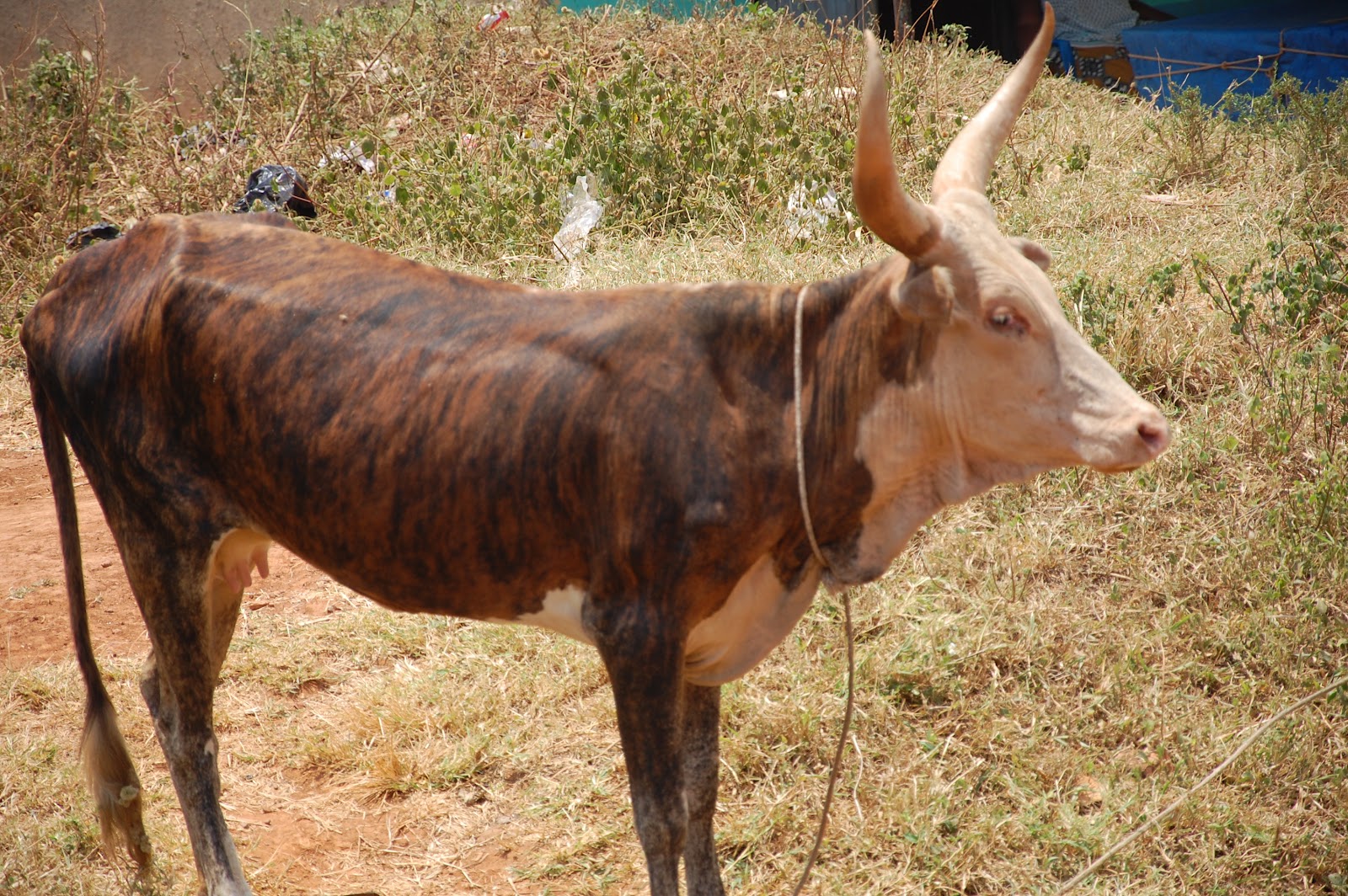
Along the way, I took several pictures of the countryside to help me remember this place which is very different from Canada in most ways.   Here is are some of the noticeable differences: people everywhere; bicycles to transport anything (especially green bananas); speed bumps; crazy drivers, lots of motorcycles (sometimes with many passengers); thin cows and goats tied up with ropes along the road side; multiple people in the back of trucks (including big ones); burning grass/brush along the side of the road; and lastly (but most common) is people walking/biking to pick up their daily water.
Typical roadside view in a developed area

Getting water for the day
6 passengers (kids) on a motorcycle (no need for a mini-van)
skinny cow along side of the road

Transporting large bunches of bananas

a truck full of cows & people

Baboon along side of road
The country side itself consists of rolling hills with very little flat land and red soil almost everywhere.  The water supplies are typically shallow wells or springs at the base of the hills.  Most rural properties use the land to host a few animals like goats, chickens and cows and grow crops like potatoes, corn and bananas.  These agricultural activities are very different from Canada as they use no machines (or chemicals) whatsoever.  Things are done at a very small scale, similar to the way it was in Canada many years ago.

As we approached Fort Portal, much of the land was planted with tea plants.  We stopped at a tea factory (premium black tea) and had a tour. 
Large fields of Tea plants
Once we arrived in Fort Portal and had lunch, we visit the office of another one WaterCans’ partner organizations who implement projects.  They are known as JESE which stands for ‘Joint Effort to Save the Environment’.  We did introductions and then JESE staff presented an overview of their work.  Following the meeting, we took a quick look at their new building.

Then we checked in at the Ruwenzori View Guest House which is located just outside of Fort Portal, in a scenic area.  We ate dinner together with some of the JESE staff at the ‘Mountains of the moon’ hotel (quite nice).

Monday, 13 February 2012

Day 2 – Visit to Rural Community (1st soccer ball gifts)


Today was another great day as we visited a rural area about 45 minutes outside of Kampala along with staff from Voluntary Action for Development (VAD) which is one of WaterCans’ partner organizations who implement projects.  Unfortunately, it rained for most of the morning which is not typical at this time of year.  This meant that our plans for the day were slightly altered and we ended up visiting a rural homestead for a couple of hours in the morning.  Following this visit, we had lunch prepared by local residents and then visited our first school.

The rural homestead was quite something!  A woman named Victoria (80 years old) lived on the property with her 10 year old grandson who’s name was Andrew.  All of us quickly became friends with Andrew as you can see from the pictures.  Near the end, I gave him one of the soccer balls and he was totally thrilled.  The pictures tell the rest of the story.
 Victoria and Andrew
Brian giving Andrew a soccer ball
A new Hand Washing setup for the family
The toilets on the property
Victoria and Andrew's house

After lunch, we visited our first school – Sacred Heart Nalubudde Primary school.  The school children were absolutely thrilled to see us and put on show for us (singing, dancing, plays, etc.).  Through funding from WaterCan and VAD, a new latrine block (toilets) has recently been constructed adjacent to the school.  And, improvements to the water supply (a spring) are now getting underway. 

school children
New latrine funded by WaterCan

I had the privilege of presenting the school headmaster some soccer balls and soccer jerseys (Tim Horton’s) for the children to keep.  I explained that the soccer balls came from Canada and were signed by school children the same age as them.  The kids were totally thrilled with the balls and it was something I will never forget!!
Soccer ball presentation to the headmaster
Kids with soccer balls on new jerseys
One of the younger siblings!!

We are off tomorrow for a 2 day trip to Fort Portal in Western Uganda.  There is no internet connection where we are staying so the blog will be silent for a few days.
I hope everyone is doing well back home in Canada!

Sunday, 12 February 2012

Day 1 – Tour of Kampala & Welcome Dinner


First of all, THANKS for all the encouragement/best wishes I received from everyone back home before leaving on my trip to Africa.  Your support and interest in my trip is much appreciated.

I arrived safely last night in Kampala, Uganda just before midnight local time, about 27 hours after leaving home on Friday.  The trip included a bus ride from Ottawa to Montreal, then two flights (Montreal to Amsterdam, then Amsterdam to Entebee) and a lastly a 1 hour van ride to Kampala.  Kampala, or more specifically the Speke Hotel, is the home base for the trip.  The hotel is the oldest hotel in the City but its quite nice – no complaints!
Speke Hotel in downtown Kampala
I am glad to report that all my fellow tour members are nice and we seem to get along well (so far).  There are 9 non-WaterCan people, plus two Canadian-based WaterCan staff and one Uganda-based WaterCan staff in the group.  The group is quite diverse with varied interests and also from various locations across Canada (Vancouver, Saskatoon, Ottawa and Toronto).  After travelling with many of them on Friday and Saturday, plus 1 full day here in Uganda I think we will all have lots of fun together on this WaterCan tour.

Day 1 details:

After a late night and early breakfast, we had an orientation session hosted by George Yap (Executive Director of WaterCan) and Cate Nimanya (Uganda-based WaterCan field staff).  Everyone had a chance to formally introduce themselves and then we learned about the water/sanitation situation in Uganda and WaterCan’s approach to making things better.  As per my previous blog, the key principles of WaterCan’s work are helping provide clean drinking water, basic sanitation, and hygiene education.  George informed us that although these principles are quite simple in theory, implementation is often not that simple.

George Yap at Orientation Meeting
Next we embarked on a tour of Kampala (population about 3 million) in a small bus.  The tour included a quick stop at a ‘market’, a visit to Uganda’s Martyrs Shrine, and a guided tour of the Buganda Parliament building and Palace (which included the torture chambers used by the former dictator Idi Amin).  Much of today’s tour was to try and teach us about the history and culture of Uganda which I know very little about.  The historical/cultural sites were very interesting – but I need to do some work to better understand some important historical events that have happened here in Uganda.

The daily living standards/ways of life for the City residents are very different here in Uganda as compared to Canada.  Some of the sights, especially the market and the small children, were quite unbelievable at first.  The children are raised with much less than we have back home – but for the most part, they seemed happy and healthy.  Later in the tour, I expect to see much worse living conditions as we visit rural areas and city slums. 
 One of the many people I met at the Market
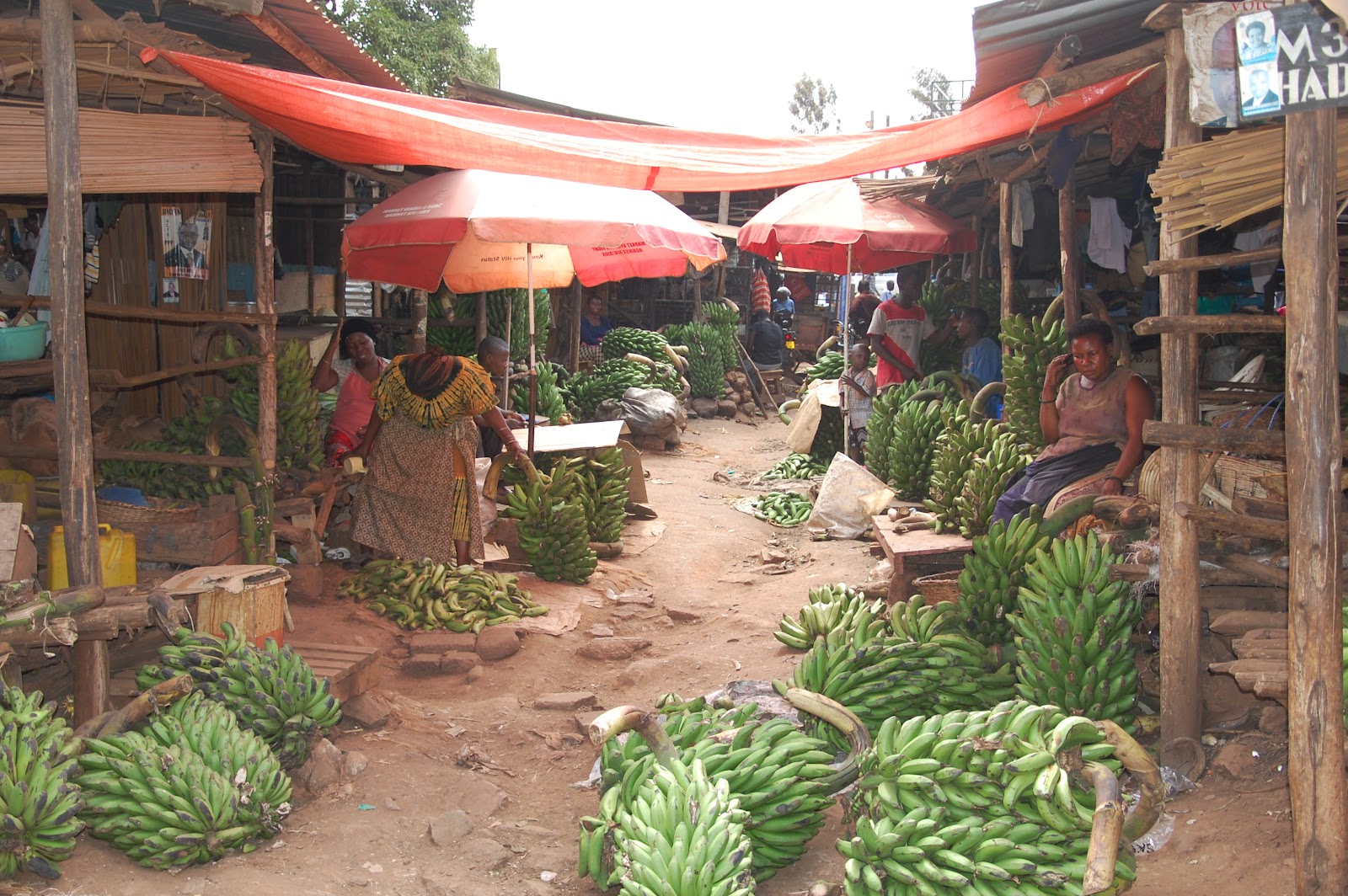
Bananas were everywhere at the Market
Young girl washing clothes
Very young girl having a bath

After a short break from 4 to 6 pm, we all headed out to the ‘official welcome dinner’ at a nearby restaurant with representatives from WaterCan’s four partner organizations (these are the people who implement the various project in Uganda).  There were about 40 people at the dinner.  This was the most formal gathering we will have this week as it included a few speeches and introductions of study tour participants.  I enjoyed talking with some of the African people and learning about them.

It’s now time for bed!  The first day was excellent and I am excited too see lots more interesting people and places in the days to come!

Tuesday, 7 February 2012

Soccer Balls for Africa


Unfortunately, gift giving by WaterCan study tour participants is generally discouraged while in Africa.  Although it may seem harmless to give small items to children (like school supplies, flags, etc.), it could easily attract a large crowd and perhaps even cause conflict and bad feelings among those who do not receive anything.  However, during the 2011 WaterCan study tour soccer balls were given out to schools with great success.

After chatting with one of last years study tour participants, Andrew Wilson of Manotick, I have decided to also bring soccer balls for this years’ tour.  My job of collecting the soccer balls was easy thanks to the generosity of the Ottawa South United Soccer Association who donated two large (hockey sized) bags of soccer balls and also two team sets of jerseys and shorts.
 
Students from Kars Public School and St. Francis de Sales (Smiths Falls) have kindly signed several of the soccer balls as a special gesture for the African kids.  I hope to visit the two schools when I return and tell the students about my trip.  I am also hoping some of the teachers follow me on my blog and share some of my experiences with their classes.


 Madame Sulphure's Grade 2 Class (Kars Public School) with two 'signed' soccer balls

Friday, 3 February 2012

Uganda at a Glance


To be honest, I do not know a lot about Uganda.  However, I hope this will change after spending 9 days in this country.  Here is what I do know about Uganda based on information provided to me by WaterCan.  As you can see from the chart below, it population is almost identical to Canada's but the land area is significantly smaller.   All other categories favour Canada in a big way!

Some interesting facts for Uganda compared to Canada:

UGANDA
CANADA
Population (million)
33.8
33.9
Child mortality (under 5 years) - per 1,000 live births
135
6
Average life expectancy at birth (years)
54.1
81.0
Water supply coverage (%)
67
100
Sanitation coverage (%)
48
100
Physicians (per 100,000 people)
8
214
GDP per capita (PPP US$)
1,251
39,035
UN Human Development Index Rank (out of 177 countries)
143rd
4th
Source: UNDP Human Development Report 2010


Uganda is located in East Africa and is also known as the "Pearl of Africa". It is bordered on the east by Kenya, on the north by South Sudan, on the west by the Democratic Republic of the Congo, on the southwest by Rwanda, and on the south by Tanzania. The southern part of the country includes a substantial portion of Lake Victoria, which is also shared by Kenya and Tanzania.  The official languages are English and Swahili, although multiple other languages are spoken in the country.  Uganda is about ¼ the size of Ontario.


Wednesday, 1 February 2012

What is a WaterCan Study Tour?


WaterCan is committed to encouraging Canadians to support efforts aimed at increasing poor people’s access to water, sanitation, and hygiene education. To help achieve this goal, WaterCan organizes annual study tours in Africa.

The 2012 WaterCan Study Tour is taking place in February 2012 in the small East African country of Uganda.  Using Kampala, Uganda’s capital, as the base, participants will have the opportunity to meet and interact with WaterCan’s local partner organizations, and project beneficiaries living in rural and urban communities.
 
The Study Tour is a unique learning experience that gives participants an opportunity to learn how WaterCan and its partners are making a difference in local communities. Upon returning to Canada, WaterCan encourages participants to share their experience with as many people as possible, and help get the word out that Water is Life.  Below is the initial itinerary for the tour:

Date
Planned Activities

Friday
Feb 10th 2012
Main group leaves Canada.
Saturday
Feb 11th, 2012
Main group arrives in Kampala and check into Speke Hotel; overnight in Kampala.
Sunday
Feb 12th, 2012
DAY 1: Morning orientation session; Kampala City tour; official welcome dinner; overnight in Kampala.
Monday
Feb 13th, 2012
DAY 2: Visit rural project sites in Wakiso District (Part 1); overnight in Kampala.
Tuesday
Feb 14th, 2012
DAY 3: Travel to Kabarole District, Western Uganda; overnight in Fort Portal.
Wednesday
Feb 15th, 2012
DAY 4: Visit rural project sites in Kyenjojo District, western Uganda; overnight in Fort Portal.
Thursday
Feb 16th, 2012
DAY 5: Return to Kampala; overnight in Kampala.
Friday
Feb 17th, 2012
DAY 6: Visit urban project sites in Kampala; overnight in Kampala.
Saturday
Feb 18th, 2012
DAY 7: Visit rural project sites in Wakiso District (Part 2); overnight in Kampala.
Sunday,
Feb 19th, 2012
DAY 8: Travel to Lake Mburo National Park, southern Uganda; overnight in Lake Mburo National Park.
Monday,
Feb 20th, 2012
DAY 9: Lake Mburo National Park in morning, return to Kampala by mid-afternoon; farewell dinner; overnight in Kampala.
Tuesday
Feb 21st, 2012
Group members check out of Speke Hotel; participants depart for Canada; Study Tour program ends.